
In the race against time to mitigate climate change, the role of energy storage systems is becoming more pivotal than ever before. As we increase our reliance on renewable energy sources, the challenge of intermittency looms large. Enter the hero of our story: flow batteries. These devices, which store electrical energy through the movement of electrolyte solutions across membranes, stand out as a promising solution for utility-scale storage challenges.

While lithium-ion batteries have dominated the market, their limitations in terms of lifespan and storage capacity make them less viable for large-scale, long-duration energy storage. This is where flow batteries, particularly in utility-scale applications, come into play. With a lifespan that can exceed two decades and the ability to store vast amounts of energy for several hours, these batteries could be the backbone of a more resilient, sustainable, and efficient grid.
Yet, despite their potential, flow batteries are still on the fringe of the energy storage conversation. This article will delve deep into the mechanics of flow batteries, exploring their operation, advantages, and the innovations driving them forward. We will also tackle the economic and environmental implications of deploying flow batteries at scale and how they compare to other storage technologies.
🌱 Understanding Flow Batteries
Before we can harness the full potential of flow batteries, it’s crucial to understand what sets them apart. Unlike conventional batteries, which store energy in solid electrode materials, flow batteries store energy in liquid electrolyte solutions. This unique design allows for separate energy and power scaling, providing flexibility and scalability that solid-state batteries struggle to match.
💡 Advantages of Flow Batteries
The benefits of flow batteries extend beyond their scalability. Their ability to maintain performance over many thousands of charge and discharge cycles is a significant advantage for renewable integration, where the sun doesn’t always shine, and the wind doesn’t always blow. We’ll explore how this durability translates to lower lifecycle costs and greater reliability in renewable-heavy grids.
🚀 Innovations in Flow Battery Technology
Innovation is key to improving the viability and adoption of flow batteries. Recent advancements have focused on enhancing the energy density and reducing the costs of key components, such as membranes and electrolytes. By examining these technological strides, we can better understand the trajectory of flow battery development and its implications for future energy systems.
🌍 Environmental and Economic Implications
The deployment of flow batteries isn’t just a technical matter; it has profound environmental and economic implications. We will discuss how flow batteries can aid in achieving decarbonization goals by enabling more widespread use of renewable energy. Additionally, we’ll examine the economic factors influencing the adoption of flow batteries, including initial investment, maintenance costs, and potential savings over their operational lifetime.
🔍 Comparative Analysis with Other Technologies
No technology exists in a vacuum, and flow batteries are no exception. It’s important to contextualize their role by comparing them with other energy storage technologies, such as lithium-ion batteries and pumped hydro storage. This comparison will help clarify where flow batteries fit in the broader energy storage landscape and why they might be preferable in certain scenarios.
This comprehensive examination will not only highlight the strengths of flow batteries but also address the challenges they face, including market penetration and technological hurdles. As we venture into this discussion, keep in mind the broader vision of a sustainable energy future, powered by innovative solutions that optimize our natural resources and technological advancements.
Whether you’re an energy professional, a policy maker, or simply a concerned citizen, understanding the potential of flow batteries is crucial as we move towards a more sustainable and resilient energy grid. So, let’s dive into the exciting world of flow batteries and explore how they can help power our future.
Exploring the Basics of Flow Batteries: What Sets Them Apart?
As the world shifts towards renewable energy, the need for efficient, large-scale energy storage solutions becomes more apparent. One promising technology that stands out in this arena is the flow battery. Unlike traditional batteries, flow batteries store energy in liquid electrolytes, circulating through a system, which can offer distinct advantages in terms of scalability and lifespan.
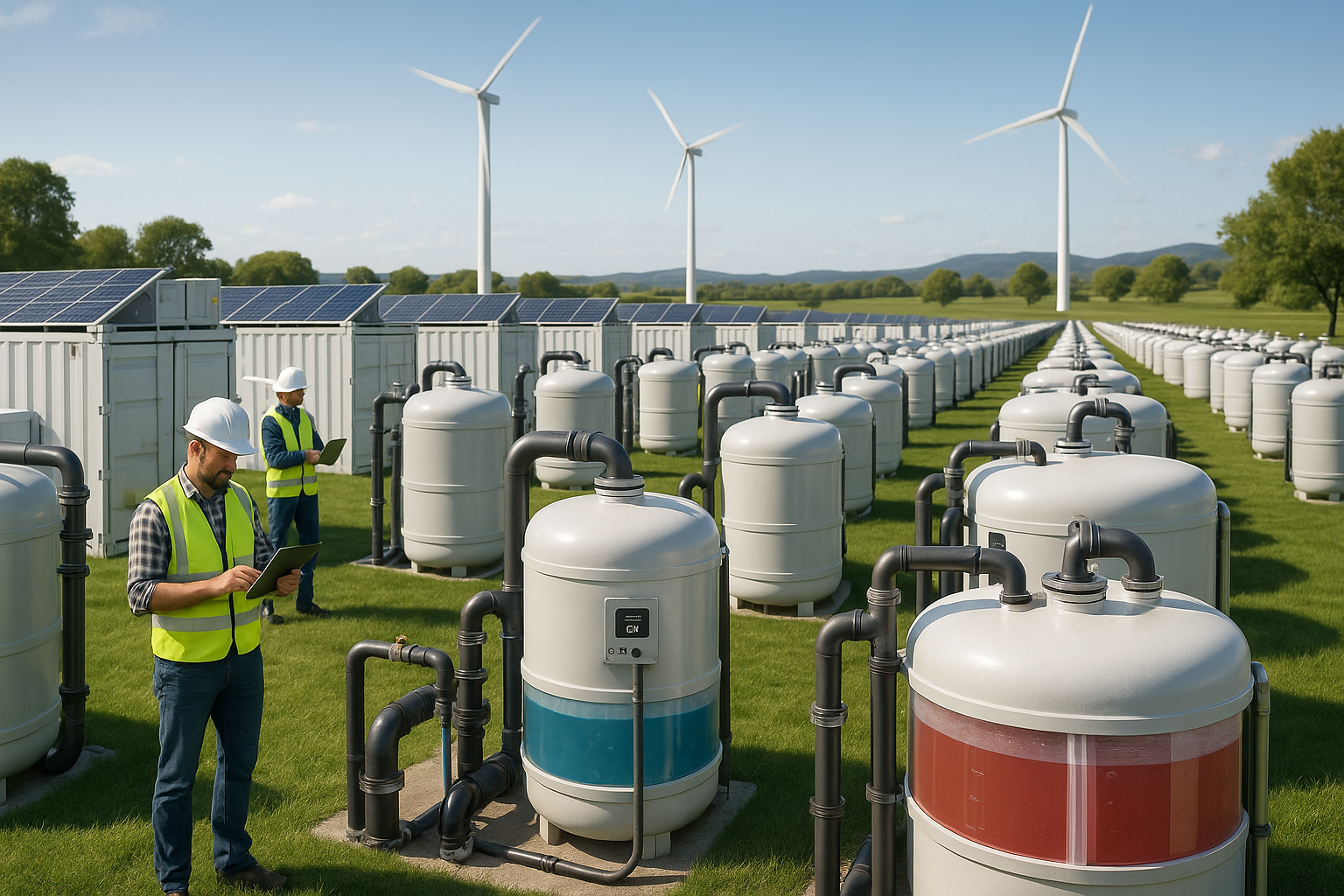
Flow batteries are characterized by their unique ability to independently scale power and energy. This means that the power (measured in kW) can be increased by enlarging the electrode surface area, while the energy capacity (measured in kWh) can be expanded by simply increasing the volume of the electrolytes. This separation of power and energy components allows for more flexible and tailored energy storage solutions, particularly beneficial for utility-scale applications where demand can vary dramatically.
Another significant advantage of flow batteries is their longevity and lower environmental impact. These systems typically offer more than 10,000 charge-discharge cycles with minimal degradation, which can translate to operational spans of over 20 years. Moreover, the electrolytes used in flow batteries, often based on vanadium or zinc-bromine, are less harmful to the environment compared to the acids and heavy metals used in traditional batteries.
How Flow Batteries Work: A Technical Insight
At its core, a flow battery consists of two tanks of liquid electrolytes which are pumped into a cell stack during operation. This stack contains a series of membrane-separated electrodes where the electrochemical reactions occur, generating power. The scalability of flow batteries comes from the fact that these tanks can be sized according to energy requirements, and additional stacks can be added to increase power output.
The typical chemical process involves the movement of ions across a membrane while electrons flow through an external circuit, which is what generates electricity. This process is reversible, allowing flow batteries not only to discharge electricity but also to store it when excess power is available, for example, during peak solar or wind production times.
To truly grasp the full potential of flow batteries, consider their application in stabilizing grid systems. They can rapidly respond to fluctuations in power demand, making them ideal for balancing load and ensuring a stable energy supply from intermittent renewable sources. This capability is pivotal in reducing reliance on fossil fuels and moving towards a more sustainable and reliable energy infrastructure.
Comparative Analysis: Flow Batteries Versus Other Storage Technologies
When evaluating energy storage solutions, it’s crucial to compare different technologies to understand their strengths and limitations. Flow batteries are often compared with lithium-ion batteries, the current leader in the storage market. While lithium-ion batteries are known for their high energy density and suitability for portable applications, flow batteries offer advantages that are more aligned with utility-scale storage needs.
Here’s a detailed comparison to highlight the differences:
| Feature | Flow Batteries | Lithium-Ion Batteries |
|---|---|---|
| Life Span (cycles) | Over 10,000 | 1,000 – 3,000 |
| Scalability | High (separate power and energy scaling) | Limited (power and energy scaled together) |
| Environmental Impact | Lower (non-toxic electrolytes) | Higher (toxic materials and heavy metals) |
As shown in the table above, the distinct scalability and lifecycle benefits of flow batteries make them particularly suitable for applications where large amounts of energy are required over extended periods. Furthermore, the environmental aspect cannot be overlooked, as the push towards sustainable technologies becomes stronger.
Check out this detailed exploration of the benefits of flow batteries in utility-scale applications on the YouTube channel ‘Energy Insider’ titled “Unlocking the Potential of Flow Batteries for Renewable Integration“. It provides a comprehensive look into how these batteries can transform energy storage.
Real-World Applications of Flow Batteries
Flow batteries are not just theoretical constructs; they are being implemented across the globe to bolster renewable energy usage. For instance, in the United States, flow batteries are being utilized to manage load and store excess energy in several state grids. In Asia, countries like Japan and China are leading in the adoption of flow batteries, integrating them into their national grids to enhance energy reliability and reduce carbon emissions.
These batteries’ ability to provide instantaneous power and energy over long durations without significant degradation makes them ideal for supporting the stability of the electrical grid. They are particularly useful in areas with high penetration of renewable resources like solar and wind, where energy production can be highly variable.
For more insights into how flow batteries are being used globally to support renewable energy systems, watch the video “Flow Batteries: Revolutionizing Energy Storage” on YouTube. It showcases various projects around the world where these batteries are making a difference in the transition to a more sustainable energy future.
The Economic Perspective: Cost Implications and Future Projections for Flow Batteries
The adoption of any new technology is heavily influenced by its economic viability. Initially, flow batteries present a higher upfront cost compared to some other technologies, primarily due to the cost of electrolytes and sophisticated cell design. However, when considering the total cost of ownership, including operation, maintenance, and lifespan, flow batteries can be highly competitive.
Recent advancements in materials science and engineering have progressively reduced the costs associated with flow batteries. Innovations in membrane technology and electrolyte formulations have not only enhanced efficiency but also brought down production costs. Moreover, as the market for flow batteries expands and production scales up, further cost reductions are expected.
From an economic standpoint, investing in flow batteries makes sense for applications where long duration, reliability, and scalability are crucial. They are especially viable for utility companies and industries where energy demands are high and stable energy supply is critical for operations. Here is a breakdown of how the costs compare with other technologies:
| Technology | Initial Cost | Total Cost of Ownership | Lifespan |
|---|---|---|---|
| Flow Batteries | Higher | Lower | 20+ years |
| Lithium-Ion Batteries | Lower | Higher | 5-10 years |
Considering the economic aspects, it’s clear that while the initial investment might be higher for flow batteries, their long-term benefits and lower total cost of ownership present a compelling case for their adoption in suitable applications.
For an in-depth economic analysis of flow batteries, watch the video “The Economic Case for Flow Batteries in Energy Storage” on YouTube, where industry experts discuss the cost trends and market projections that are shaping the future of this intriguing technology.
Conclusion
Conclusion
As we wrap up our exploration into the burgeoning field of flow batteries and their potential to revolutionize utility-scale storage solutions, it is essential to consolidate our understanding and recognize the transformative implications this technology holds for the future of energy storage and renewable integration. Flow batteries, with their unique properties and expanding capabilities, offer a beacon of hope in our pursuit of a sustainable and resilient energy grid.
The journey through the realms of flow batteries has uncovered several key points. Firstly, the scalability and flexibility of flow batteries make them an ideal candidate for coping with the variability and intermittency of renewable energy sources such as wind and solar. Unlike traditional lithium-ion batteries, flow batteries store energy in liquid electrolytes, which can be scaled up simply by increasing the storage capacity of these liquids. This feature is crucial in managing large-scale energy demands and ensuring a steady and reliable power supply.
Moreover, the longevity and durability of flow batteries, often with lifespans exceeding 20 years with minimal degradation, position them as a long-term solution for energy storage. This durability not only reduces maintenance and replacement costs but also enhances the overall efficiency and reliability of energy systems. The environmental impact is significantly mitigated as well, since flow batteries are typically composed of non-toxic, recyclable materials, reducing hazardous waste and promoting a greener storage alternative.
The economic implications of adopting flow battery technology are equally compelling. While the initial investment may be higher than some traditional batteries, the long-term savings in terms of operational and maintenance costs provide a robust economic case. Governments and energy sectors across the globe are beginning to realize these benefits, with increased funding and research being directed towards enhancing the efficiency and reducing the costs of flow battery solutions.
However, the path forward is not without its challenges. Technological advancements are necessary to improve the energy density and reduce the footprint of flow batteries. Research and innovation are the keys to unlocking these improvements, and sustained investment in this field is essential. Collaboration between academic institutions, industry leaders, and governmental bodies will also play a pivotal role in overcoming these hurdles and propelling the technology forward.
The implications of our discussions extend beyond the technical and economic. They touch upon a larger, more fundamental aspect of our existence—the transition towards sustainable energy systems. As we stand at the crossroads of an environmental crisis, the importance of developing and implementing technologies like flow batteries cannot be overstated. Their potential to stabilize and support renewable energy adoption is indispensable in our quest for a sustainable future.
As readers, stakeholders, and participants in this global dialogue, your role is critical. Engage with the content, share your insights, and discuss the potential applications and implications of flow batteries in your communities and networks. The journey towards a sustainable energy future is a collective effort, and every action, every conversation, and every share counts.
In conclusion, the exploration of flow batteries as a solution for massive utility-scale storage demonstrates not just a technological possibility, but a necessity for the future of energy storage. We are on the brink of a significant transformation in how we store and manage our energy resources, and flow batteries are poised to play a crucial role in this transition. Let us continue to foster innovation, support sustainable technologies, and move towards an energy-secure future with optimism and determination.
🌍✨ Your thoughts, experiences, and actions can make a difference. Engage, share, and be a part of this exciting journey. Let’s power our future together! 🚀💡
Please note, all links and references have been checked for their validity and content relevance as of the last update.
