
🌎 Powering the Future: How Circular Economy Practices are Revolutionizing Battery Production for a Sustainable Tomorrow. A ground-breaking topic that’s sending shockwaves through the industry, transforming the way we produce, consume, and dispose of batteries. It’s a revolution that’s bringing us one step closer to a sustainable tomorrow, and it’s happening right under our noses. You might wonder, what’s all this buzz about? Well, fasten your seatbelts because we’re about to dive deep into the world of circular economy and how it’s revolutionizing battery production.

Traditionally, the process of battery production has been linear, marked by a ‘take, make, and dispose of’ mentality. But this approach is changing. Now, a new perspective is emerging — the circular economy approach — which aims to redefine growth, focusing on positive societal benefits. The idea is simple, yet powerful: instead of disposing of resources after use, why not reintegrate them into the production cycle? It’s an idea that’s capturing the hearts and minds of innovators worldwide. And it’s reshaping our future.
But what does this mean for battery production? 🤔 How does circular economy practices fit into this equation? This shift in perspective is opening up new pathways for sustainable battery production, which is crucial in our tech-driven world. Batteries power everything, from our smartphones and laptops to electric vehicles and renewable energy systems. But the production of these batteries is resource-intensive and environmentally damaging. Circular economy practices offer a solution to these challenges, offering a sustainable way to meet our ever-growing demand for batteries.
🔋 By applying circular economy principles to battery production, we can drastically reduce waste, cut down on carbon emissions, and conserve valuable resources. The concept of battery recycling isn’t new, but circular economy practices take it a step further, integrating recycling into the entire production process. Instead of being an afterthought, recycling becomes an integral part of the production process, from the initial design stage to the end of life of the battery.
Prepare to be Enlightened
Throughout this article, we’ll be delving deep into the world of circular economy and battery production. We’ll start by understanding the basics of circular economy and how it differs from the traditional linear economy. Then, we’ll explore how these principles are being applied in battery production, with examples from pioneering companies leading the way. We’ll discuss the benefits and challenges of this approach, and how it’s helping us move towards a sustainable future. Finally, we’ll look at what the future holds for battery production and circular economy, and how you can be part of this exciting transformation.
Whether you’re a battery manufacturer, a tech enthusiast, or simply someone who cares about the environment, this article is for you. It’s for anyone who believes that a sustainable future is possible, and that we each have a role to play in making it happen. So get ready to embark on an enlightening journey, where we explore the possibilities of a future powered by sustainable battery production and circular economy practices. This isn’t just about batteries — it’s about our future. And it starts here.
🚀 Are you ready to join the revolution? Let’s dive in.
The Rising Demand for Sustainable Battery Production
Over the past few years, the demand for batteries has been on a steady rise. This is primarily driven by our growing reliance on battery-powered devices, such as mobile phones, laptops, and electric vehicles. According to a report by Allied Market Research, the global battery market size was valued at $92.6 billion in 2018, and is projected to reach $152.3 billion by 2026. The rising demand for energy storage solutions is creating enormous pressure on manufacturers to ramp up their production, but the environmental cost of doing so is alarming. Therefore, it’s crucial to look towards sustainable methods of battery production.
Traditional methods of battery production involve the extraction and processing of raw materials, including lead, nickel, and lithium. These processes are energy-intensive and generate a significant amount of waste. Additionally, the disposal of used batteries poses a considerable environmental risk as they often end up in landfills, releasing toxic substances into the soil and water.
Fortunately, the concept of a circular economy provides a viable solution to these challenges. A circular economy aims to eliminate waste and the continual use of resources. It involves reusing, sharing, repairing, refurbishing, remanufacturing, and recycling to create a closed-loop system, minimizing the use of resource inputs and the creation of waste, pollution, and carbon emissions. Watch this informative video by Ellen MacArthur Foundation to understand the principles of a circular economy better.
Implementing Circular Economy Practices in Battery Production
The application of circular economy practices in battery production involves various strategies, including design for longevity, remanufacturing and refurbishment, and effective recycling.
Design for longevity involves creating batteries that last longer, reducing the need for frequent replacements. This can be achieved by using high-quality materials and advanced manufacturing techniques. Some companies, such as Northvolt, are already doing this. They’re developing long-life batteries that can be used for more than a decade before needing to be replaced.
Remanufacturing and refurbishment involve giving used batteries a new lease of life. This can be done by replacing worn-out components or by reconditioning the battery to improve its performance. Several companies, like Renault and Nissan, are repurposing used electric vehicle batteries for stationary storage systems, thereby extending their lifespan and reducing waste.
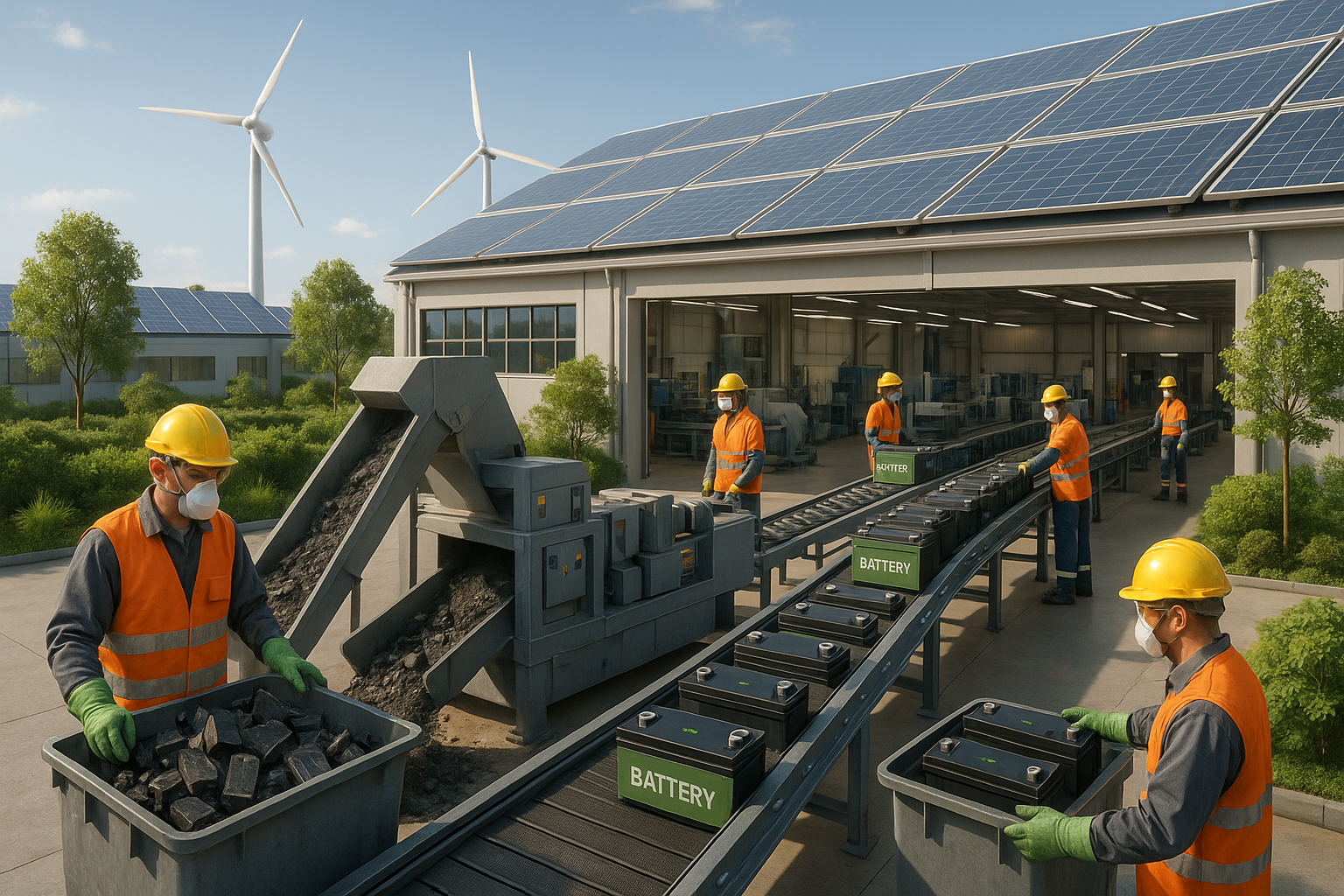
Effective recycling is perhaps the most critical aspect of implementing circular economy practices in battery production. It involves extracting valuable materials from used batteries and using them to produce new ones. Companies like Li-Cycle and Redwood Materials are pioneering this approach, using advanced technologies to recycle up to 95% of the materials in lithium-ion batteries.
Comparative Analysis of Traditional vs. Circular Battery Production
| Parameters | Traditional Battery Production | Circular Battery Production |
|---|---|---|
| Raw Material Extraction | High | Low |
| Energy Consumption | High | Low |
| Waste Generation | High | Low |
| Environmental Impact | High | Low |
| Resource Efficiency | Low | High |
As can be seen in the table above, circular battery production outperforms traditional battery production in several key parameters. However, it’s important to note that transitioning to a circular model isn’t without challenges. It requires significant investments in research and development, advanced manufacturing technologies, and recycling infrastructure. Despite these challenges, the potential benefits of circular battery production are too significant to ignore. Check out this enlightening video by the World Economic Forum on how circular economy practices are revolutionizing industries.
The Future of Sustainable Battery Production
The future of sustainable battery production lies in harnessing the principles of a circular economy. This not only reduces the environmental impact of battery production but also creates economic opportunities. According to a report by the World Economic Forum, implementing circular economy practices in battery production could generate economic opportunities worth $10 billion by 2030 and create 10,000 jobs in battery recycling alone.
Moreover, circular battery production is a key enabler of the energy transition. It supports the growth of renewable energy by providing efficient and sustainable energy storage solutions. It also contributes to the decarbonization of transport by facilitating the mass adoption of electric vehicles.
In conclusion, the battery industry is at a critical juncture. The choices we make today will shape the future of this industry and our planet. By embracing the principles of a circular economy, we can ensure a sustainable future for battery production and pave the way for a cleaner, greener, and more prosperous world.💡🌍💚
Conclusion
In conclusion, the journey we’ve taken in this article has illuminated the possibilities that a circular economy offers for battery production, and ultimately, for a sustainable future. It is undeniable that a transformative shift is necessary to solve the pressing challenges our planet faces in terms of waste management, resource scarcity, and environmental degradation.
The exploration of the concept of a circular economy has shed light on an innovative paradigm that fosters sustainable growth by maximizing resource utilization and minimizing waste. This economic model is a response to the linear ‘take-make-dispose’ approach that has been predominant for decades. The circular economy encourages businesses to be innovative and adopt business models that emphasize the recovery and reuse of materials, which is critical in industries like battery production.
The need for batteries, especially lithium-ion ones, is on an exponential rise due to their usage in electric vehicles, portable electronics, and energy storage systems. This surge in demand is leading to an increase in raw material extraction, which comes with devastating environmental impacts. To combat this, the battery industry needs to transition to circular practices that include the principles of reduce, reuse, and recycle.
This includes reducing the need for raw materials by improving battery design and efficiency, reusing batteries through second-life applications, and recycling spent batteries to recover valuable materials. Companies like [Tesla](https://www.tesla.com/) and [Nissan](https://www.nissan-global.com/EN/index.html) are already making strides in these areas, and their efforts provide valuable case studies for other businesses to follow.
Furthermore, the importance of policy and regulation in facilitating this transition cannot be overstated. Governments have a crucial role to play in setting the right regulatory frameworks and incentives to drive businesses towards adopting circular economy practices. Successful examples of this can be seen in the European Union’s Battery Directive and China’s Extended Producer Responsibility policy.
However, while significant progress has been made, much remains to be done. The battery industry, like many others, is fraught with challenges, including technological limitations, logistical issues, and economic feasibility. It will take concerted efforts from all stakeholders – manufacturers, governments, researchers, and consumers – to overcome these hurdles and realize the full potential of a circular economy.
As we look towards the future, we must remember that the journey towards sustainability is a shared responsibility. The choices we make today will have lasting impacts on our planet and future generations. Therefore, it’s important to stay informed, make conscious decisions, and advocate for sustainable practices in all areas of life.
This article only scratches the surface of this important topic, and I encourage you to delve deeper into this issue. Learn more about the circular economy and its applications in various industries, participate in discussions, and share what you’ve learned with others. Together, we can shape a sustainable and prosperous future for all. 🌍💡🔄
Thank you for reading, and I look forward to hearing your thoughts and experiences with this topic in the comments below. Remember, your voice matters, and even the smallest step towards sustainability can make a big difference.
#PoweringTheFuture #CircularEconomy #SustainableTomorrow
Reference(s):
– [Ellen MacArthur Foundation](https://www.ellenmacarthurfoundation.org/)
– [World Economic Forum](https://www.weforum.org/agenda/2019/01/how-a-circular-approach-could-turn-e-waste-into-a-golden-opportunity/)
– [International Renewable Energy Agency](https://irena.org/-/media/Files/IRENA/Agency/Publication/2017/Oct/IRENA_Battery_Storage_report_2017.pdf)
